
Tembalang, Semarang – Thursday, December 22, 2022
The fieldwork practice (PKL) for Master of Public Health students concentrating in Hospital Administration (ARS) at hospitals aims to enhance graduates’ competency so that they are well-prepared to manage hospitals effectively. Specifically, after completing the fieldwork practice (PKL), ARS concentration students are expected to:
a. Be able to explain the organizational structure and main tasks according to the hospital’s organizational structure (SOTK) at the PKL location.
b. Describe the types of hospital services, the service delivery process, and the working relationships in outpatient, inpatient, emergency, and supporting service units (such as laboratory, radiology, nutrition, medical records, CSSD, and IPSRS).
c. Explain the main tasks and functions of managerial support divisions (such as directors, administration and finance, human resource development, and training), as well as various hospital committees formed for specific purposes (such as the quality and patient safety committee, medical committee, and nursing committee) within the hospital service system at the PKL location.
d. Identify the necessary resources (manpower, finances, materials, and management methods) to provide hospital services at the PKL location.
e. Identify managerial/administrative issues in one of the hospital’s work units at the PKL location.
f. Analyze alternative problem-solving strategies and determine the priority solutions for managerial/administrative issues in one of the hospital’s work units at the PKL location.
During this PKL period, students undertook fieldwork practice for four weeks and were given the freedom to choose their PKL location, provided it aligned with the PKL guidelines set by the Master of Public Health Program at Undip. The hospitals had to be classified as Type A, B, C, or D, whether public or private.
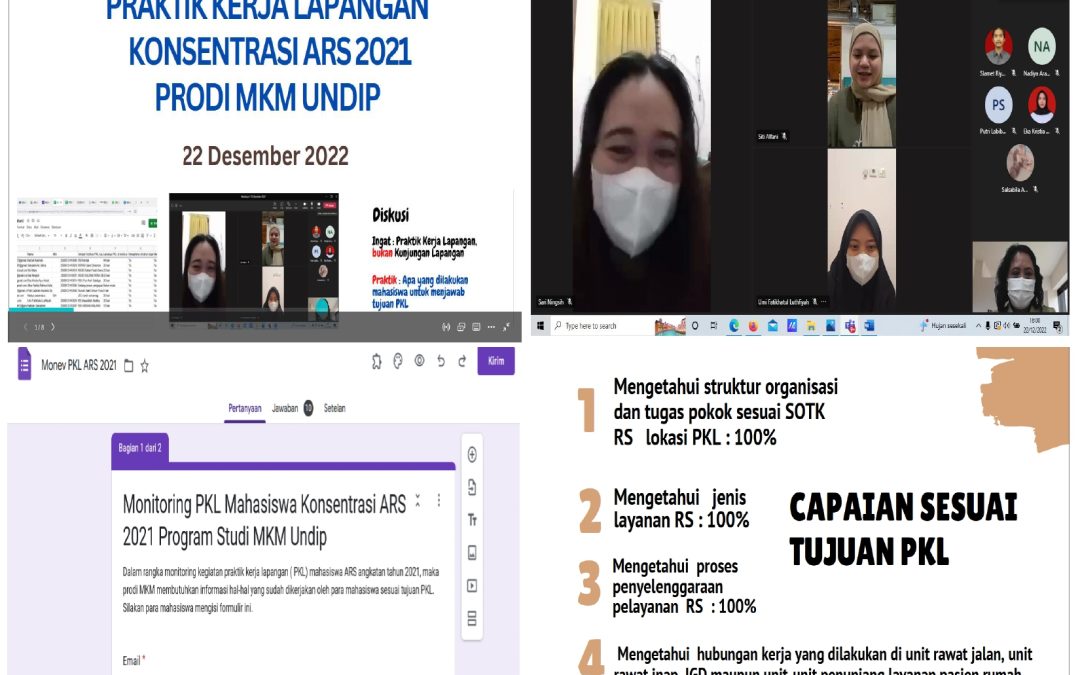
To assess the PKL process undertaken by students, monitoring was conducted by the Master of Public Health Program. The monitoring aimed to evaluate the students’ PKL activities and identify any challenges encountered during their practice. The monitoring process involved students completing a questionnaire via Google Forms on December 19, 2022, followed by an online meeting on December 22, 2022.
Based on the questionnaire results, it was found that students had carried out their PKL activities in accordance with the guidelines. However, not all PKL objectives were fully achieved (80-100%). Some of the challenges faced during PKL included hospitals undergoing accreditation processes, students managing PKL while working, adjustments to practical materials following hospital schedules, and availability of field supervisors at PKL locations.
At the end of the monitoring session, it was concluded that PKL activities should not only involve observation and interviews but also hands-on practice aligned with the PKL objectives.
Author: Cahya Tri Purnami – Master of Public Health, Faculty of Public Health, Diponegoro University.